Call or Text: 219-232-8133
Consumer Confidence Report (CCR) for Willow Creek Crossing
Date 6/15/2026
Willow Creek Crossing
3574 W US Hwy 20, LaPorte, IN 46350
PWSID#: IN5246009
2025 Drinking Water Quality Report for Willow Creek Crossing
(Este informe contiene información muy importante sobre su agua potable. Tradúzcalo o hable con alguien que lo entienda bien.)
PWSID: IN5246009
Contact Person: Omar, Community General Manager (219-232-8133)
Date of Publication: June 15, 2026
1. Water System and Source Information
Willow Creek Crossing provides groundwater from two on-site community wells drawing from a localized aquifer:
WELL #1 - WEST - FLOWING WELL (Groundwater)
WELL #2 - EAST - FLOWING WELL (Groundwater)
Our system maintains an active Wellhead Protection Program to safeguard our local aquifer from potential contamination. Information regarding this program, as well as opportunities for public participation and scheduling, can be obtained by directly contacting our community management office.
2. Explanation of Contaminants Reasonably Expected to be Found
The sources of drinking water (both tap water and bottled water) include rivers, lakes, streams, ponds, reservoirs, springs, and wells. As water travels over the surface of land or through the ground, it dissolves naturally occurring minerals and, in some cases, radioactive material, and can pick up substances resulting from the presence of animals or from human activity.
Drinking water, including bottled water, may reasonably be expected to contain at least small amounts of some contaminants. The presence of contaminants does not necessarily indicate that water poses a health risk. More information about contaminants and potential health effects can be obtained by calling the EPA's Safe Drinking Water Hotline at 1-800-426-4791.
Contaminants that may be present in source water include:
Microbial Contaminants: Such as viruses and bacteria, which may come from sewage treatment plants, septic systems, agricultural livestock operations, and wildlife.
Inorganic Contaminants: Such as salts and metals, which can be naturally occurring or result from urban stormwater runoff, industrial or domestic wastewater discharges, oil and gas production, mining, or farming.
Pesticides and Herbicides: Which may come from a variety of sources such as agriculture, urban stormwater runoff, and residential uses.
Organic Chemical Contaminants: Including synthetic and volatile organic chemicals, which are by-products of industrial processes and petroleum production, and can also come from gas stations, urban stormwater runoff, and septic systems.
Radioactive Contaminants: Which can be naturally occurring or be the result of oil and gas production and mining activities.
In order to ensure that tap water is safe to drink, the EPA prescribes regulations which limit the amount of certain contaminants in water provided by public water systems. FDA regulations establish limits for contaminants in bottled water which must provide the same protection for public health.
3. Standard Regulatory Definitions
Maximum Contaminant Level (MCL): The highest level of a contaminant that is allowed in drinking water. MCLs are set as close to the MCLGs as feasible using the best available treatment technology.
Maximum Contaminant Level Goal (MCLG): The level of a contaminant in drinking water below which there is no known or expected risk to health. MCLGs allow for a margin of safety.
Action Level (AL): The concentration of a contaminant which, if exceeded, triggers treatment or other requirements which a water system must follow.
Action Level Goal (ALG): The level of a contaminant in drinking water below which there is no known or expected risk to health. ALGs allow for a margin of safety.
Treatment Technique (TT): A required process intended to reduce the level of a contaminant in drinking water.
ppm (parts per million): Milligrams per liter (mg/L), or one ounce in 7,350 gallons of water.
ppb (parts per billion): Micrograms per liter (µg/L), or one ounce in 7,350,000 gallons of water.
picocuries per liter (pCi/L): A measure of the radioactivity in water.
Avg: Average regulatory compliance with some MCLs are based on a running annual average of monthly samples.
4. Required Health & Vulnerability Language
Some people may be more vulnerable to contaminants in drinking water than the general population. Immuno-compromised persons such as persons with cancer undergoing chemotherapy, persons who have undergone organ transplants, people with HIV/AIDS or other immune system disorders, some elderly and infants can be particularly at risk from infections. These people should seek advice about drinking water from their health care providers. EPA/CDC guidelines on appropriate means to lessen the risk of infection by Cryptosporidium and other microbial contaminants are available from the Safe Drinking Water Hotline (1-800-426-4791).
There is no safe level of lead in drinking water. Exposure to lead in drinking water can cause serious health effects in all age groups, especially pregnant people, infants (both formula-fed and breastfed), and young children. Some of the health effects to infants and children include decreases in IQ and attention span. Lead exposure can also result in new or worsened learning and behavior problems. The children of persons who are exposed to lead before or during pregnancy may be at increased risk of these harmful health effects. Adults have increased risks of heart disease, high blood pressure, kidney or nervous system problems. Contact your health care provider for more information about your risks.
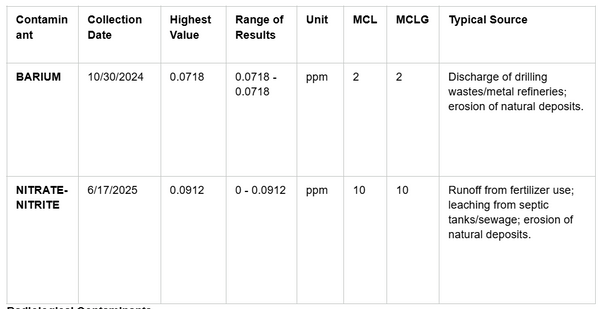
5. Detected Contaminants Data Table (2025 Testing)
Chemical sampling of our drinking water may not be required on an annual basis; therefore, information provided in this table refers back to the latest year of required testing results.
Lead and Copper (2025 Sampling)
Regulated Contaminants
Radiological Contaminants
Microbiological Contaminants
6. Mandatory Disclosure of Past Monitoring and Administrative Violations
During the periods noted below, our water system experienced administrative, timeline, and reporting violations. We worked directly with the Indiana Department of Environmental Management (IDEM) to resolve these issues and have successfully fulfilled our corrective requirements to return to complete compliance.
Mandatory Health Effects Language for Total Coliform:
Coliforms are bacteria that are naturally present in the environment and are used as an indicator that other, potentially harmful, bacteria may be present. Coliforms were found in more samples than allowed, and this was a warning of potential problems. Corrective steps and flushed samples have resolved this issue.
7. Lead Service Line Inventory Access Instructions
In accordance with federal Lead and Copper Rule Improvements (LCRI), Willow Creek Crossing has completed its initial Lead Service Line inventory framework. Our certified utility records confirm 0 Lead lines and 0 Galvanized Requiring Replacement (GRR) lines on-site, with 19 connections verified as non-lead and 10 currently classified as unknown.
Residents can publicly access and interactively view our complete certified utility materials ledger and transparency map at any time via our dedicated 120Water Public Transparency Dashboard at:https://pws-ptd.120wateraudit.com/WillowCreekCrossing-IN.
CCR Public Posting Locations: The 2025 CCR for Willow Creek Crossing (IN5246009) was physically posted at the central cluster mailboxes on June 22, 2026.